


Serve Robotics reported third-quarter results on Thursday and used the same afternoon to announce a second business. The company best known for googly-eyed sidewalk delivery robots launched Physical AI Services, a line that sells the connectivity and data tools it built for its own fleet to other companies building robots for farms, warehouses and other uncontrolled environments.
Chief executive Ali Kashani described the logic without dressing it up. The company, he said, is solving the problem of robots in human spaces, and it has spent years learning what breaks when a machine has to operate in a world full of pedestrians, weather, bad wifi and unmarked curbs. Selling that knowledge is a different business from delivering burritos, and he framed it in the language of platform economics: taking technology built for internal use and opening it to others to build on.
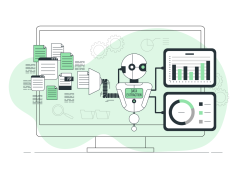
The offering has three parts. Serve Link connects robots in the field to AI models running in data centers, so a machine can lean on heavier compute without carrying it onboard. A data curator tool helps developers sift the raw footage a robot collects and surface the rare edge cases worth training on. The third product is a catalog of real-world data gathered by Serve's own sidewalk fleet, intended to teach models how cluttered human environments actually behave.
There is one named customer. Bedrock Robotics, a startup building self-driving systems for construction equipment, is using the service. Serve also said it is working with T-Mobile to push AI computing closer to where robots operate, which is a sensible partnership for a company selling connectivity: the carrier already owns the hard part of reliable links over unreliable networks.
The strategic argument is that robotics is fragmenting. Dozens of companies are building machines for specific tasks, and each of them is rebuilding the same plumbing, from fleet telemetry to over-the-air updates to the data pipeline that turns field footage into training sets. If that plumbing became a shared layer, the way cloud infrastructure did, the company that owns it would earn recurring revenue from machines it did not have to build.
That is the pitch. The numbers are harder to read. Serve reported $2.84 million of revenue for the September quarter, up 313 percent from $687,000 a year earlier, a growth rate flattered by a tiny base and by its acquisition of Diligent Robotics, the hospital robot maker. Sequentially, revenue fell from $3.24 million in the June quarter. Full-year guidance of about $12 million implies a fourth quarter roughly the size of the third, which is not acceleration.
The loss line is the constraint. Net loss widened to $59.2 million from $33.0 million a year earlier. Daily active robots averaged 917 in the quarter, up from 312, and recurring revenue accounted for 69 percent of the mix, both genuine signs of an operating business. But the delivery side is shifting partners, with volume through Uber Eats running below expectations and growth moving toward DoorDash and Wonder, and hospital robots contributed $4.6 million across the first nine months, roughly half of what the company has booked this year.
Investors marked the announcement down. The stock fell about 12 percent on the day to roughly $2.30, even though the quarter beat the forecasts published ahead of it. That reaction says the market treated the platform as a headline rather than a business, and the criticism is fair on the disclosed record: one customer, one carrier partnership, and no pricing or revenue for the new line.
The skepticism has substance beyond the disclosure gap. Connectivity in unpredictable conditions is what a mobile carrier sells, which is probably why Serve partnered with T-Mobile instead of competing with it. Compute belongs to the cloud providers. Perception hardware already has entrenched suppliers whose depth cameras are designed into delivery robots, humanoids, agricultural machines and forklifts. Each layer of the stack Serve wants to sell is already occupied by a specialist, and the most proprietary asset it holds, sidewalk footage, is real but narrow.
Against that, the AWS comparison is not absurd, just early. Cloud infrastructure became dominant because Amazon built it to solve an enormous internal problem, then found that the solution was broadly useful and hard to replicate. Serve has the first half of that story: a fleet, a data pipeline, and operating experience in messy public space. What it does not yet have is evidence that another company will depend on its layer for a repeated job and pay for it on an ongoing basis.
For logistics operators, the practical interest is different from the investor argument. Warehousing and delivery fleets are buying more autonomous machines and fewer integrated systems, and the integration work, telemetry, exception handling and model retraining is where projects stall. A vendor offering that as a service is worth evaluating, particularly for mid-sized operators that cannot staff a robotics platform team. The questions to ask are unglamorous: what happens to the data, who owns the model improvements, what the uptime commitment is, and how the contract handles a network outage at 2am.
Serve has $198 million of cash and marketable securities, which gives it room to fund the bet. It also has a delivery business that consumes cash faster than it generates it. The platform will be judged the way platforms always are, by named customers that pay, return, and say the alternative was harder. Until that shows up in revenue rather than in a press release, the AWS framing is a reasonable ambition and an unfinished argument.